
By LEVEL 08 Composite Structures & Fabrication | Updated October 2026
If you're planning to purchase a custom fiberglass tank, one of your first questions is probably, "How much is this going to cost?"
Fair question. Unfortunately, there isn't a universal price tag for custom fiberglass tanks.
A 500-gallon tank used for holding freshwater fish is an entirely different project from a 500-gallon chemical-processing vessel. They may hold the same amount of liquid, but their structural requirements, materials, fittings, and manufacturing costs can be very different.
At LEVEL 08, we manufacture fiberglass-reinforced plastic (FRP) tanks for aquaculture, water treatment, industrial processing, and specialized applications.
We know that buyers need more than a vague answer about pricing. You need to understand what you're paying for, which specifications actually matter, and where you might be able to reduce costs without compromising performance.
This guide explains how custom fiberglass tanks are priced, what drives manufacturing costs, and how to prepare for a more accurate quotation.
How Much Does a Custom Fiberglass Tank Cost?
For initial budgeting, a relatively simple fiberglass tank may cost a few thousand dollars, while large, heavily reinforced, or specialized tanks can cost tens of thousands of dollars or more.
Here are broad planning ranges for common atmospheric, non-pressure fiberglass tank projects in the United States.
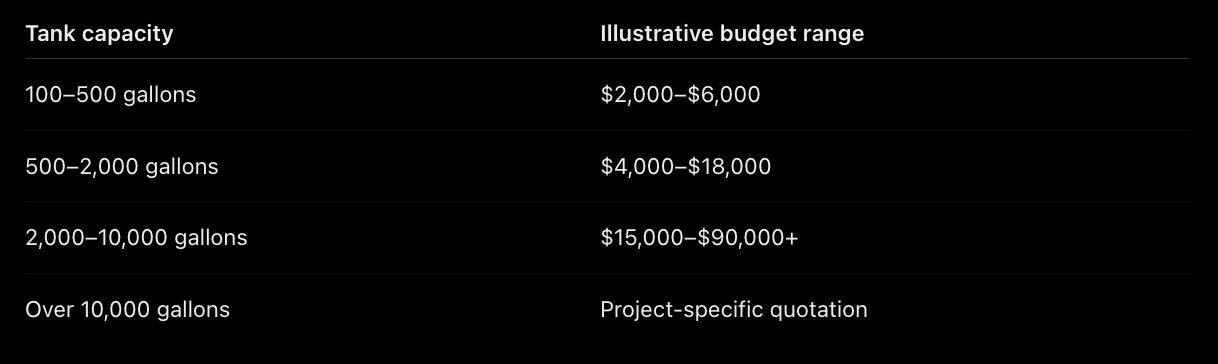
Important: These are preliminary budgeting allowances, not LEVEL 08 selling prices, guaranteed market averages, or formal quotations. They are informed by publicly advertised fiberglass tank pricing and the wide range of custom fabrication requirements. Actual prices may fall outside these ranges.
These estimates generally assume atmospheric tanks used for water or similar services. They do not necessarily include custom tooling, specialty resin systems, substantial reinforcements, freight, installation, engineering certification, or unusual accessories. Pressure vessels require separate evaluation.
Why such wide ranges?
Because gallons tell us how much a tank holds. They don't tell us how difficult it is to manufacture.
A tank's shape, height, laminate construction, resin system, intended application, and fabrication method can all affect its final price.
Let's look at what goes into the numbers.
1. Tank Dimensions and Surface Area
A common misconception is that fiberglass tanks should be priced strictly by the gallon.
Capacity matters, but it isn't the entire equation.
During early estimating, manufacturers may calculate the surface area of a tank to estimate how much fiberglass reinforcement, resin, gel coat, and labor the project will require.
Consider a rectangular tank measuring:
8 feet long × 4 feet wide × 3 feet deep
Its theoretical internal volume is:
8 × 4 × 3 = 96 cubic feet
96 × 7.4805 = approximately 718 US gallons when filled to the brim, before accounting for wall thickness or any internal components.
Now consider the surface area of an open-top version:
Bottom: 8 × 4 = 32 square feet
Two long walls: 2 × (8 × 3) = 48 square feet
Two end walls: 2 × (4 × 3) = 24 square feet
Total nominal internal surface area: 104 square feet
That's approximately 104 square feet of laminate-bearing surface, before allowing for flanges, overlaps, stiffeners, reinforcements, trimming, and other manufacturing details.
This helps explain why two tanks with similar capacities can require different amounts of material and labor.
A tall, narrow tank and a shallow, wide tank may hold similar volumes, but their surface areas and structural loading conditions will not be identical.
The takeaway: If you want accurate fiberglass tank pricing, provide both the desired capacity and the dimensions. One number alone rarely tells the whole story.
2. Fiberglass Thickness and Structural Requirements
Wall thickness is one of the most important factors affecting custom fiberglass tank costs.
But there's a detail worth understanding: thicker fiberglass is not automatically better fiberglass.
A properly designed laminate must account for the intended loading conditions, reinforcement arrangement, resin system, support configuration, and allowable deflection.
For example, an open-top tank sitting on a continuously supported foundation may require a different structural design than a tank mounted on a steel frame with unsupported spans.
Tank height also matters because liquid pressure increases with depth.
For freshwater, the hydrostatic pressure at the bottom of a tank increases by approximately 0.433 psi for every foot of liquid depth.
That may sound insignificant until you consider the pressure acting across an entire tank wall.
At LEVEL 08, laminate construction is selected around the application rather than assuming that every fiberglass product should have the same reinforcement schedule.
Depending on the project, manufacturing may involve materials such as chopped-strand reinforcement, woven roving, biaxial fiberglass, and additional reinforcement in areas subjected to concentrated loads.
The objective isn't simply to make a tank heavy. It's to build it appropriately for the job.
And yes, adding fiberglass just because "more must be stronger" is a surprisingly expensive way to avoid making a proper design decision.
3. Resin Selection: Polyester vs. Vinyl Ester
Fiberglass tanks aren't made from glass reinforcement alone.
The resin system binds the reinforcement together and contributes to the finished laminate's chemical resistance and mechanical performance.
Two common resin families used in fiberglass manufacturing are polyester and vinyl ester.
Polyester Resin
Appropriately selected polyester resin systems can provide a practical and economical solution for many general-purpose fiberglass applications.
They may be suitable for certain water-handling and non-aggressive service environments, provided the formulation matches the operating conditions.
Vinyl Ester Resin
Vinyl ester systems are often considered for applications requiring enhanced resistance to certain chemicals, moisture exposure, and demanding operating environments.
They can be more expensive than general-purpose polyester systems, but the additional material cost may be justified when the service conditions demand it.
At LEVEL 08, our fabrication capabilities include application-specific resin and laminate selection.
For industrial and chemical tanks, a responsible manufacturer should request the chemical name, concentration, operating temperature, specific gravity, cleaning chemicals, and expected exposure conditions before recommending a resin system.
A tank designed for freshwater shouldn't automatically be assumed suitable for concentrated chemicals.
The cheapest resin is not the best value if it's incompatible with the liquid you're storing.
4. Tank Shape: Round, Rectangular, Oval, or Cone-Bottom?
The geometry of your tank can have a major impact on its manufacturing cost.
Round Fiberglass Tanks
Round tanks are widely used in fish farming, recirculating aquaculture systems (RAS), hatcheries, and general liquid storage.
Their geometry can offer efficient structural performance and circulation advantages, depending on the inlet and outlet design.
When an existing mold can be used, round tanks may also offer manufacturing efficiencies.
Explore LEVEL 08 fiberglass aquaculture tanks.
Rectangular Fiberglass Tanks
Rectangular tanks are particularly useful when floor space, equipment layout, or production line configuration requires a specific footprint.
They're common in hatcheries, research facilities, aquaculture raceways, industrial processing, and specialty containment.
However, flat walls and corners can require additional structural attention to control deflection under liquid loading.
That can mean additional reinforcement, structural stiffeners, and more fabrication labor.
Oval Fiberglass Tanks
Oval tanks can provide a practical compromise between capacity and facility layout.
They're useful when a long, narrow installation area makes a circular tank impractical but circulation and operating capacity remain important.
Cone-Bottom Fiberglass Tanks
Cone-bottom tanks are frequently specified where gravity-assisted drainage and solids collection are priorities.
Applications include aquaculture filtration, sludge handling, process liquids, and specialty treatment systems.
Additional fabrication considerations may include cone geometry, lower outlet reinforcement, support structures, and drain connections.
Which shape is cheapest?
There isn't one universal answer. For repeatable designs, an existing mold can make a substantial difference. For a custom project, the most economical shape is the one that meets the operating requirements without unnecessary fabrication complexity.
5. Custom Mold and Tooling Costs
One of the biggest differences between buying a standard fiberglass tank and ordering a completely custom one is the tooling.
Many fiberglass products are fabricated using molds that define the finished shape.
If a suitable mold already exists, the manufacturer may be able to avoid much of the upfront tooling work.
But if you require unusual dimensions, a specialized bottom, unique corners, or a complex geometry, a new mold may be necessary.
Custom tooling can involve design review, dimensional planning, construction of the mold or plug, surface preparation, release systems, and manufacturing trials.
That is real work, even before the first production tank is completed.
At LEVEL 08, we offer both existing tank geometries and custom fiberglass fabrication for projects that need something different.
We also manufacture custom composite molds and tooling.
For customers ordering multiple identical tanks, tooling costs may be distributed across the production quantity.
This is one reason that ordering ten identical tanks can produce a different per-unit price than ordering one prototype.
6. Gel Coat, Interior Finish, and Surface Requirements
The visible surface of a fiberglass tank does more than make it look attractive.
For many applications, the interior finish influences cleanability, maintenance, and resistance to the intended operating environment.
Commercial aquaculture facilities, for example, often need smooth interiors that can be cleaned between production cycles.
An appropriate gel coat or corrosion barrier system can form part of that solution.
Depending on the project, finish requirements may involve specific surface preparation, coating chemistry, application thickness, color, and additional quality-control work.
Chemical containment applications may require a dedicated corrosion barrier designed around the stored material.
It's important not to confuse a cosmetic finish with a complete chemical-resistance specification.
When comparing quotations, confirm exactly what interior and exterior finish systems are included.
Two tanks can look almost identical in photographs while having very different material specifications.
7. Drains, Fittings, Flanges, Windows, and Accessories
A basic open-top fiberglass tank is generally less complicated than a fully equipped tank with custom plumbing connections and integrated components.
Depending on the application, additional features might include bottom drains, overflow connections, molded flanges, reinforced openings, removable lids, partitions, inspection windows, lifting provisions, or equipment mounting points.
Some accessories require additional materials. Others require changes to the mold or laminate construction.
An acrylic viewing window, for example, isn't simply a sheet of clear plastic attached to the side of a tank. The opening, window thickness, sealing arrangement, supporting structure, and installation method all need consideration.
Likewise, a bottom drain may require local reinforcement and careful detailing to avoid leakage and maintenance problems.
These details are best identified before fabrication begins.
Changing a drain location on a drawing is usually much easier than changing it after the tank has been manufactured.
8. Shipping, Handling, and Installation
Freight can be a meaningful part of the overall project budget, especially for large fiberglass tanks.
Fiberglass is generally lighter than many comparable conventional structural materials, but an oversized tank still takes up a lot of space on a truck.
Shipping costs depend on dimensions, weight, destination, packaging, handling arrangements, and whether special transportation requirements apply.
For larger projects, also consider site access, unloading equipment, foundation or support preparation, and installation responsibilities.
LEVEL 08 manufactures in Cocoa, Florida, and serves customers beyond Florida.
When requesting a quotation, include your delivery ZIP code and any site-access limitations so transportation can be considered early.
A tank that fits perfectly in the CAD drawing but cannot get through the facility entrance is not an especially successful design.
9. How Tank Applications Affect Pricing
The same nominal capacity can lead to very different specifications depending on how the tank will be used.
Aquaculture and Fish Hatchery Tanks
For aquaculture facilities, important considerations may include tank geometry, water circulation, drainage, cleanability, compatible materials, and ease of maintenance.
A basic holding tank may be less expensive than a purpose-built hatchery tank with specialized outlets, compartments, or filtration integration.
Industrial Water and Wastewater Tanks
Industrial tanks may require particular dimensions, supports, chemical resistance, access provisions, and connections to existing treatment equipment.
The best fabrication solution depends on the operating conditions rather than capacity alone.
Chemical Storage and Containment Tanks
Chemical tanks require special attention to compatibility, operating temperature, concentration, specific gravity, ventilation, containment, and applicable design requirements.
A chemical tank should never be specified using only its gallon capacity.
Fiberglass Pressure Vessels
Pressure vessels are a separate category from atmospheric storage tanks.
Design pressure, operating cycles, nozzle loads, testing requirements, and applicable engineering codes can significantly change the scope and price.
An atmospheric-tank budget should not be used to estimate a pressure vessel.
LEVEL 08 also provides custom fiberglass pressure tank fabrication for suitable industrial and treatment applications, subject to project-specific design and compliance requirements.
10. Fiberglass vs. Plastic vs. Steel: Which Offers Better Value?
Initial purchase price is only one part of equipment cost.
For standard, smaller-volume storage applications, a commercially available polyethylene tank may be less expensive than a custom fiberglass tank.
That doesn't automatically make it the best solution for every job.
Custom fiberglass can become attractive when the project requires a particular shape, substantial rigidity, specialized fittings, a compatible corrosion-resistant construction, or integration into existing equipment.
Steel can be a strong choice for certain structural and process applications. But depending on the liquid and environment, corrosion protection and maintenance may become important ownership costs.
Fiberglass offers a different combination of design flexibility, corrosion resistance, strength-to-weight performance, and surface options.
The right material depends on the operating conditions and the total cost of ownership.
Before comparing prices, make sure you're comparing products that are actually designed to perform the same job.
A lightweight plastic tank and a heavily reinforced custom FRP vessel are not necessarily interchangeable just because both hold 1,000 gallons.
11. How to Reduce Custom Fiberglass Tank Costs Without Sacrificing Quality
Lowering the price of a custom tank doesn't always require lowering its quality.
In many cases, the biggest savings come from making the design easier and more efficient to manufacture.
Start by reviewing the geometry. If an existing mold can meet your requirements, you may avoid the expense of new tooling.
Specify the actual operating conditions. Don't automatically request a high-cost resin system or additional thickness unless the application requires it.
Keep accessories practical. A simple drain configuration may be more economical than several custom penetrations, provided it still meets the process requirements.
Consider production quantities. If you expect to need several identical tanks over time, share that information with the manufacturer. It may influence tooling, production planning, and unit cost.
Be realistic about delivery. Early planning may allow more flexibility in manufacturing and transportation arrangements than a last-minute order.
Most importantly, tell the fabricator what the tank needs to do—not just how you think it should be built.
Sometimes a simple design change can achieve the same functional result at a lower cost.
A good manufacturing partner should be willing to have that conversation.
12. What Information Do You Need for an Accurate Fiberglass Tank Quote?
The more clearly your requirements are defined, the more useful your quotation will be.
Before contacting a fiberglass tank manufacturer, prepare the following information:
Application: What will the tank contain or be used for?
Capacity and dimensions: Required gallons, length, width, diameter, height, and any size restrictions.
Configuration: Round, rectangular, oval, cone-bottom, open-top, or covered.
Operating conditions: Liquid type, chemical concentration, temperature, specific gravity, and whether pressure or vacuum is involved.
Structural support: Floor-supported, elevated, frame-mounted, buried, or otherwise supported.
Accessories: Drains, flanges, fittings, lids, windows, partitions, or special features.
Quantity: One prototype, several identical units, or ongoing production.
Delivery details: Destination ZIP code, required delivery date, and any unloading limitations.
If you have a CAD model, engineering drawing, rough sketch, or photographs of an existing tank, include those as well.
You don't have to arrive with every engineering detail completed. But the intended application needs to be clear enough for the manufacturer to evaluate the design properly.
Why Work With LEVEL 08 for Custom Fiberglass Tanks?
LEVEL 08 Composite Structures & Fabrication is an American fiberglass manufacturer based in Cocoa, Florida, with manufacturing roots tracing back to 1991 through American Eagle's composite craftsmanship.
Our work spans custom aquaculture tanks, industrial FRP fabrication, pressure tank applications, and composite mold manufacturing.
We work with customers who need more than an off-the-shelf container.
Some projects begin with completed CAD drawings. Others begin with a set of dimensions, an existing component, or an operational challenge that needs a practical solution.
We understand that the quality of a fiberglass product depends on details that aren't always visible in the finished surface: resin compatibility, reinforcement selection, laminate construction, proper support, and attention to fittings and finishing.
Our approach is to understand the application, review the manufacturing requirements, and develop a practical fabrication solution.
Whether you need a single custom tank, a replacement component, or multiple units for a larger facility, we're interested in understanding what the project actually demands.
Because a fiberglass tank isn't successful simply because it looks good when it leaves the shop. It has to work when it reaches yours.
Frequently Asked Questions About Fiberglass Tank Costs
How much does a 1,000-gallon fiberglass tank cost?
A relatively straightforward 1,000-gallon open-top tank may fall in the several-thousand-dollar range, while a fully customized tank can cost substantially more. Geometry, material specifications, tooling, reinforcements, accessories, and freight all affect the price.
Are custom fiberglass tanks more expensive than polyethylene tanks?
Often, yes—especially when comparing one-off fiberglass fabrication against mass-produced polyethylene tanks. However, custom fiberglass may offer advantages for unusual dimensions, special fittings, structural requirements, and certain demanding operating environments.
Does thicker fiberglass always mean a better tank?
No. The correct laminate depends on the tank's geometry, loading conditions, support arrangement, material system, and intended use. Unnecessary thickness increases material and labor costs without necessarily creating a better design.
Is a round fiberglass tank cheaper than a rectangular tank?
It can be, particularly when a suitable existing mold is available. Rectangular tanks may require additional wall reinforcement, but actual cost depends on size, geometry, production quantity, and specifications.
Can I order a fiberglass tank to my exact dimensions?
Yes. LEVEL 08 offers custom fiberglass fabrication for projects requiring specific shapes, dimensions, fittings, and construction requirements.
Is freight included in fiberglass tank pricing?
Not necessarily. Transportation should be identified separately in the quotation, particularly for oversized tanks or projects requiring specialized handling.
How long does it take to manufacture a custom fiberglass tank?
Lead time depends on design complexity, mold availability, material requirements, quantity, and the current production schedule. A repeat product made using existing tooling may follow a different production timeline from a first-of-its-kind custom tank.
Can I get a quote without engineering drawings?
Yes. You can begin with dimensions, capacity, intended use, photographs, or a rough sketch. More detailed information may be needed before the design and final quotation are confirmed.
Ready to Find Out What Your Fiberglass Tank Will Cost?
A useful quotation starts with understanding what you need—not guessing from a gallon capacity.
At LEVEL 08, we manufacture fiberglass tanks and custom FRP products around real operating requirements. If you're planning an aquaculture facility, updating a water-treatment system, sourcing industrial containment equipment, or developing a specialized tank, we'd like to review your project.
Tell us what you're building, what the tank needs to handle, and where it needs to go.
We'll help evaluate the fabrication requirements and discuss a practical path forward.
Request a Custom Fiberglass Tank Quote
LEVEL 08 Composite Structures & Fabrication
798 Clearlake Road, Unit #106
Cocoa, Florida 32922
Email: sagar@level08compositestructures.com
Phone: (315) 262-6612
American-made fiberglass manufacturing. Built around your application.