
Glass Grades
| Type of Fiberglass | Description |
|---|---|
| E-Glass (Electrical Grade) | The most widely used fiberglass grade, offering a balance of strength, electrical insulation, moisture resistance, and cost. Commonly used in boats, tanks, pipes, circuit boards, and wind turbine blades. |
| S-Glass and R-Glass | High-performance grades with superior tensile strength, stiffness, and heat tolerance. Used in aerospace components, defense equipment, armor, and performance sports gear. |
| C-Glass (Chemical Grade) | Offers improved resistance to acids and harsh chemicals. Often used as a corrosion-resistant surface layer in industrial tanks and pipes. |
| ECR-Glass (Corrosion-Resistant Grade) | A boron-free grade that retains the electrical properties of E-glass while offering improved acid resistance. Commonly used in industrial pipes, pultruded profiles, and chemical storage tanks. |
| AR-Glass (Alkali-Resistant Grade) | Contains zirconium to withstand alkaline environments. Used in glass-reinforced concrete cladding, cement products, and architectural panels. |
| D-Glass (Low-Dielectric Grade) | Allows radio and microwave signals to pass through with minimal loss. Used in radar covers, antennas, and high-frequency electronic components. |
| A-Glass (Alkali Grade) | Has a chemical composition similar to ordinary window glass. It is rarely preferred for structural composites because of its limited performance in damp or chemically aggressive environments. |
Why does one fiberglass part last for decades while another cracks early? The answer usually comes down to the types of fiberglass used to build it. Fiberglass is not one single material. It is a family of glass fibers and resins. Each mix behaves differently.
Quick answer: Fiberglass is grouped in two ways. By glass grade, the common choices are E-glass, S-glass, C-glass, ECR-glass, AR-glass, D-glass and A-glass. By form, it comes as chopped strand mat, roving, woven roving, cloth, veil and tape. The grade sets strength and chemical resistance. The form sets how the part is shaped and where it is strongest.
What Is Fiberglass, Exactly?
Fiberglass is a composite material. You may also see it called fibreglass, glass fiber or GRP (glass-reinforced plastic). Very fine glass fibers are set in a resin. The resin is usually polyester, vinyl ester or epoxy. The glass carries the load. The resin holds the fibers in place and protects them.
This pairing is why fiberglass is so popular. It is light and strong for its weight. It does not rust or rot. It is easy to mold into large shapes. It is also non-conductive and non-magnetic. For a full beginner's overview, read our guide on what is fiberglass.
One quick note. Fiberglass insulation is a different product. Those pink or yellow batts in a wall are made of glass wool. This article covers structural fiberglass, also called FRP (fiber-reinforced plastic). That is what industrial tanks, boat hulls, pools and canoes are made from.
What Are the Main Types of Fiberglass?
Glass fibers start as melted silica sand and other minerals. The molten glass is drawn into thin filaments. Change the recipe and you change the glass grade. Here are the grades you will meet most often.
E-Glass (Electrical Grade)
E-glass is the workhorse. It is the most widely used reinforcement in composites. It offers a good balance of strength, electrical insulation, moisture resistance and cost. Its density is about 2.54 g/cm³. You will find it in boat hulls, tanks, pipes, circuit boards and wind blades.
S-Glass and R-Glass (High-Strength Grade)
S-glass is the premium structural option. It has higher tensile strength, stiffness and heat tolerance than E-glass. "S" is the U.S. name. R-glass is the European equivalent. It costs more. You will see it in aerospace parts, defense gear, armor and high-end sports equipment.
C-Glass (Chemical Grade)
C-glass resists acids and harsh chemicals better than standard E-glass. It is usually made into thin surface veils. These veils form the chemical-resistant inner layer of tanks and pipes. It is rarely used as the main structural layer.
C-Glass (Chemical Grade)
ECR-glass is a boron-free upgrade of E-glass. It keeps the electrical properties. It also resists acid attacks much better. It is common in pultruded profiles, pipes and chemical storage tanks.
AR-Glass (Alkali-Resistant Grade)
Concrete is highly alkaline. Ordinary glass breaks down in it. AR-glass contains zirconium, so it survives. It is used to reinforce cement products. Examples include glass-reinforced concrete cladding and thin architectural panels.
D-Glass (Low-Dielectric Grade)
D-glass lets radio and microwave signals pass with very little loss. That makes it useful for radar covers, antennas and high-frequency electronics. It is less common. It costs more and is weaker than E-glass.
A-Glass (Alkali Grade)
A-glass is high in alkali. Its chemistry is close to window glass. It holds up poorly in damp or chemical settings. Today it is rarely the first choice for composites.
Quick Comparison
| Glass Grade | Known For | Typical Uses |
|---|---|---|
| E-glass | Best all-round value and electrical insulation | Tanks, boats, pipes, circuit boards |
| S-glass / R-glass | Highest strength and heat tolerance | Aerospace, defense, performance sports gear |
| C-glass | Chemical resistance | Corrosion-resistant surface veils for tanks and pipes |
| ECR-glass | Acid resistance with E-glass properties | Pultruded profiles, pipes, chemical tanks |
| AR-glass | Resistance to alkaline concrete | Glass-reinforced concrete panels |
| D-glass | Low signal loss | Radar covers, antennas, high-frequency electronics |
| A-glass | Chemistry similar to window glass | Limited use in structural composites |
Fiberglass Forms: Mat, Roving, Cloth and More
Grade is only half the story. Glass fiber also comes in different forms. The form decides how a part is built. It also decides where the strength sits.
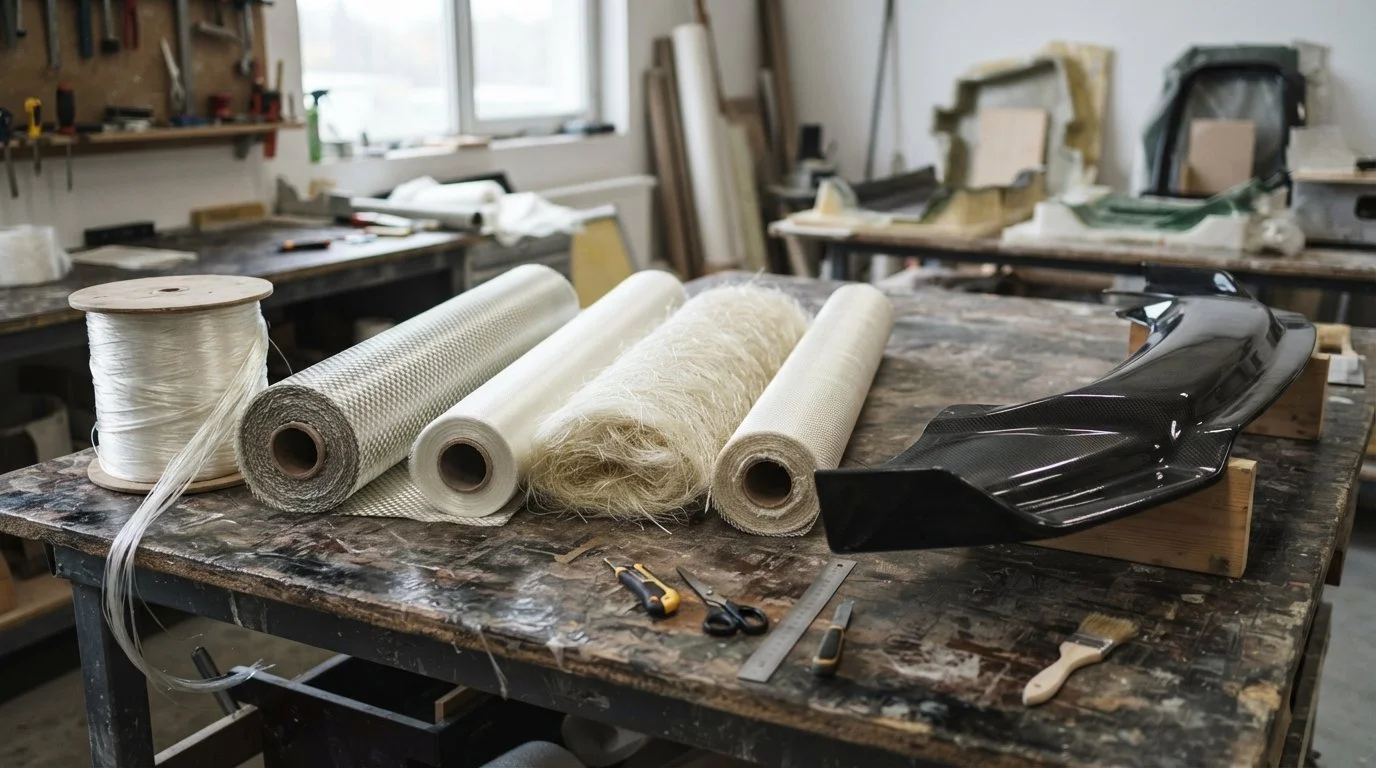
Chopped strand mat (CSM): Short fibers laid at random and held with a binder. It bends around curves easily. It gives equal strength in every direction. Common in molds, tanks and boat hulls.
Roving: Long, untwisted strands wound on spools. It feeds filament winding, pultrusion and spray-up. Long fibers give high strength.
Woven roving: Heavy roving woven into a coarse fabric. It adds thickness and stiffness fast.
Fiberglass cloth: A finer woven fabric. It gives a smoother surface and strong, directional reinforcement. It suits repairs and detail work.
Veil or surfacing mat: A very thin layer for the surface. It creates a smooth, corrosion-resistant finish.
Fiberglass tape: Narrow woven strips. They reinforce seams, corners and edges.
Multiaxial fabrics: Layers of fiber pointing in different directions. They add strength along specific load paths. Vacuum-infused hulls often use them.
Resins: The Other Half of the Laminate
The same glass and resin can become very different products. The process makes the difference.
Hand lay-up: Fiber and resin are applied by hand, layer by layer, over a mold. It is flexible. It suits large custom pieces like tanks and pools.
Spray-up: Chopped fiber and resin are sprayed together. It covers large surfaces fast.
Vacuum infusion: Dry fiber is sealed in a mold. Resin is then pulled through under vacuum. The laminate is lighter and has very few voids.
Filament winding: Continuous roving is wound around a spinning mandrel. It makes pipes and round vessels.
Pultrusion: Fibers are pulled through resin and a heated die. It makes rods, beams and channels.
Need a part that does not exist off the shelf? Custom FRP fabrication lets you match the grade, form, resin and process to your exact size and conditions.
Key Properties, Advantages and Drawbacks
Advantages
Strong for its weight (about one-third the density of steel)
Does not rust or rot, and resists moisture and many chemicals
Non-conductive and non-magnetic
Does not warp easily, and has low thermal conductivity
Easy to mold into complex, seamless shapes
Long life with low maintenance
Drawbacks
Costs more upfront than some basic plastics
Less stiff than steel, so good design matters
Can fade or chalk in strong sun unless protected by gel coat or paint
Does not biodegrade, and recycling options are limited
Cutting and sanding make irritating dust, so wear gloves, eye protection and a respirator
How to Choose the Right Fiberglass
Choosing between fiberglass types is easier with three questions. What will the part touch? How much load will it carry? What is your budget? Water, chemicals, salt, concrete and electricity all point to different choices.
Which Types of Fiberglass Suit Tanks, Boats and Canoes?
Chemical and water tanks: E-glass or ECR-glass, plus a C-glass veil, bonded with vinyl ester resin. This gives a strong shell and a corrosion-resistant inner surface.
Pressure vessels: Continuous roving and woven reinforcement, wound or laminated to the pressure rating.
Boat hulls and canoes: E-glass cloth and multiaxial fabrics, often vacuum infused. The hull is lighter and consistently strong.
Molds and tooling: Chopped strand mat and woven roving with tooling gel coats. This keeps dimensions accurate and the surface durable.
High-performance parts: S-glass, when weight savings and peak strength justify the cost.
Common Uses of Fiberglass
Fiberglass resists corrosion and takes almost any shape. You will find it in construction, marine, aerospace, automotive, water treatment, chemical processing, power generation, aquaculture and recreation.
Fluid systems are a good example. Fiberglass pressure tanks avoid the corrosion, weight and upkeep problems of steel vessels. They hold up well in chlorinated water, brine, mild acids and fertilizer solutions.
Fiberglass vs. Steel, Aluminum, Concrete and Plastic
Steel is strong but heavy and rusts unless it is coated and maintained. Aluminum is lighter but can corrode in salt or chemical settings and is harder to form into complex shapes. Concrete is durable but heavy, porous and prone to cracking and surface breakdown. Polyethylene is lightweight and inexpensive but has limits in strength, temperature and size.
Fiberglass sits in a sweet spot. It is lighter than metal, more rigid than most plastics, and easier to customize than concrete. The purchase price is sometimes higher up front, but the lifetime cost is often lower because there is less to repair or replace.
Frequently Asked Questions
-
E-glass is the most common grade. It balances strength, electrical insulation, corrosion resistance and price. That is why most boats, tanks and general FRP products use it. Most buyers start here unless they need higher strength or special chemical resistance.
-
S-glass is the strongest of the commonly used grades. It is called R-glass in Europe. It has higher tensile strength and heat resistance than E-glass. It also costs more. That is why it is mostly used in aerospace, defense and performance products.
-
Structural fiberglass is glass fiber bonded in resin to make rigid parts. Fiberglass insulation is loose glass wool. It traps air and slows heat flow. The two share a name and a raw material. They do not share a purpose.
-
Pound for pound, fiberglass can match or beat steel, and it will not rust. Steel usually has higher total strength and stiffness. The right choice depends on the job, the load and the design. Many corrosive or wet settings favor fiberglass.
-
Fiberglass is a composite of glass fibers and plastic resin. The resin is the plastic part. The glass fibers add strength. That is why it is also called fiber-reinforced plastic, or FRP.
-
Yes. Fiberglass can be molded to almost any shape. You can also tune the glass grade, fabric form, resin and gel coat. This lets you balance chemical exposure, pressure, appearance and budget for each project.
-
Cured fiberglass is stable and safe in daily use. Cutting, grinding or sanding releases fine dust and fibers. Always wear gloves, eye protection and a respirator during that work.
Final Thoughts
Knowing the types of fiberglass makes every material choice easier. Match the grade to the environment. Match the form to the shape and load. Match the resin to the chemistry. The result is a part that lasts for decades, not seasons.
LEVEL 08 Composite Structures builds custom FRP products at its Cocoa, Florida facility. We ship across the United States. Not sure which fiberglass setup fits your project? Send us your drawings, sizes and operating conditions. Request a quote and our team will help you choose the right laminate.