
How Is Fiberglass Manufactured
If you've ever wondered how a bundle of glass and a can of resin turns into a tank, a pool shell, or a canoe, you're asking a fair question. Fiberglass looks simple from the outside, but the manufacturing process behind it involves melting sand into fiber, weaving that fiber into fabric, and building it up layer by layer with resin until it becomes something rigid enough to hold water, resist pressure, or float you down a river.
We've been doing this by hand and by vacuum infusion for more than 30 years. Here is the real process, start to finish, in plain language.
Quick Answer: How Fiberglass Is Made
Step 1: Silica sand, limestone and other minerals are melted at high heat.
Step 2: The molten glass is drawn through tiny holes to form thin glass fibers.
Step 3: Fibers are coated, gathered into strands, and woven into mat, cloth or roving.
Step 4: The fiber is combined with a liquid resin (polyester, vinyl ester or epoxy) using a molding method such as hand lay-up, spray-up, vacuum infusion or filament winding.
Step 5: The resin cures and hardens, locking the fibers into a rigid composite, ready to be trimmed, finished and shipped.
Step 1: Turning Sand Into Glass Fiber
Every fiberglass product starts the same way, as raw minerals. Manufacturers melt silica sand along with limestone, kaolin clay and other minerals in a furnace at temperatures above 1,400°C (roughly 2,550°F).
Once the glass is molten, it is pushed through a plate with hundreds of tiny holes called a bushing. Each hole is smaller than a millimeter across, so what comes out the other side is not glass in any shape you'd recognize. It's an extremely thin filament, thinner than a human hair.
These filaments are coated with a chemical finish called sizing, which protects them and helps the resin bond to them later. The coated filaments are then gathered into bundles called strands or rovings. How many filaments go into a bundle, and how thick each one is, determines the final weight of the fiber material.
Step 2: Turning Fiber Into Usable Material
Raw glass fiber on its own isn't something you can build a tank out of. It has to be formed into a usable format first. The main forms are:
Chopped strand mat: Fibers are cut short and laid in random directions, bound together loosely. Good for general-purpose layers and complex curves.
Woven roving and cloth: Fibers are interlaced like fabric, giving high strength in specific directions. This is what we use for the structural layers in our tanks and pool shells.
Continuous strand mat: Molten glass is dispensed directly onto a moving belt, cooled, bound, and rolled into a long mat.
Continuous rovings: Long, uncut bundles used in processes like filament winding and pultrusion, where fiber needs to be fed continuously through machinery.
At this stage, the material still isn't fiberglass. It's still just glass fiber. Nothing becomes fiberglass until it meets resin.
Step 3: Combining Fiber and Resin
This is the step most people actually mean when they ask how fiberglass is manufactured, it's where fiber and resin finally become one solid material.
The fiber (mat, cloth or roving) is combined with a liquid resin, usually polyester, vinyl ester or epoxy. The resin flows around and between every fiber, then cures into a hard, rigid plastic. Once cured, the fibers can no longer move or separate. They're locked in place, and the resin transfers stress evenly across the whole structure. That's what gives fiberglass its strength-to-weight advantage over solid plastic or metal.
The way this combination happens depends on the manufacturing method, and different methods suit different products which is exactly the kind of decision our custom FRP fabrication team works through with every client before a mold is even built.
Step 4: Choosing a Fiberglass Manufacturing Method
There isn't just one way to build a fiberglass product. The right method depends on size, shape, volume and the performance the final part needs.
Hand lay-up
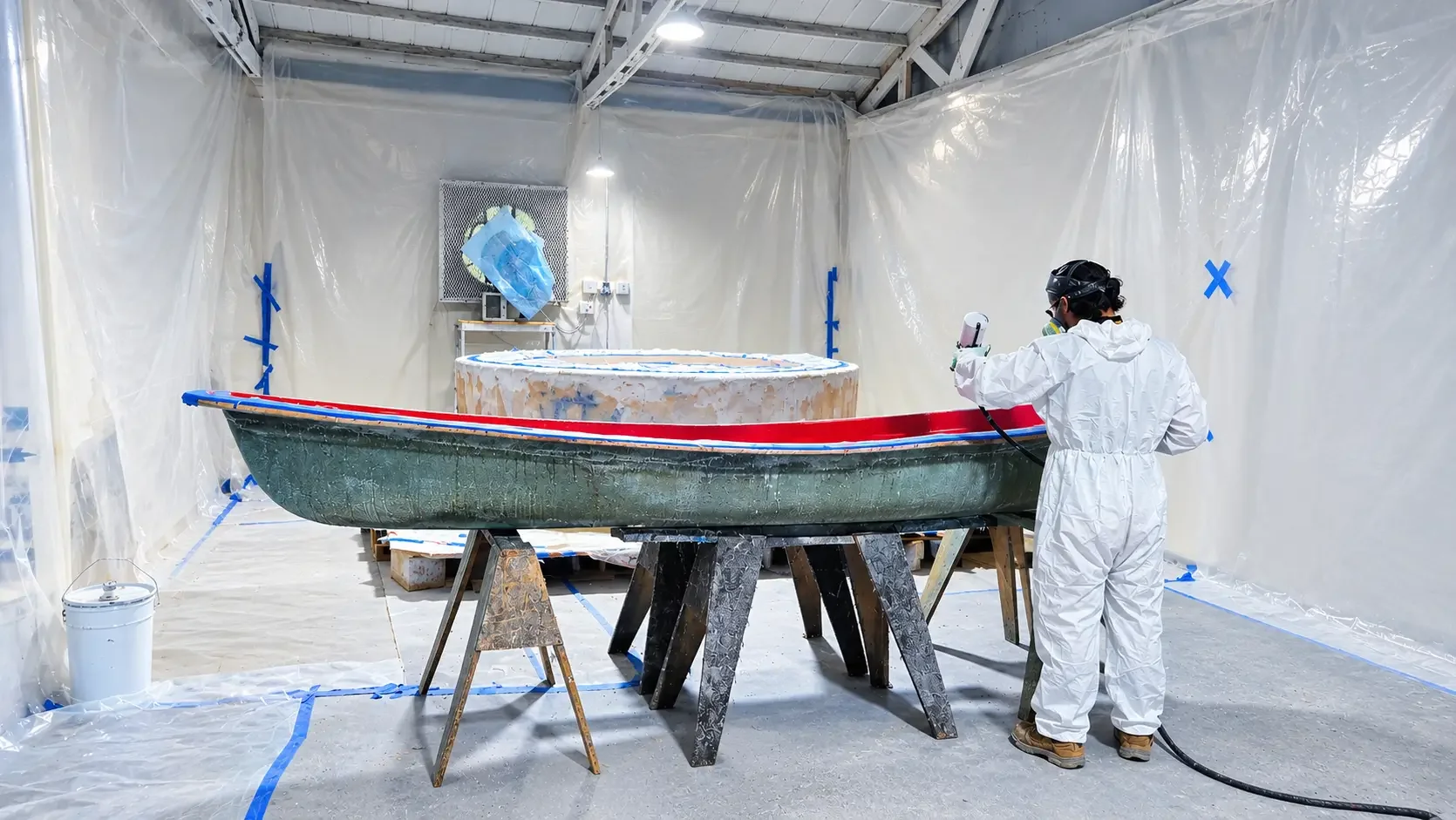
Workers place layers of fiber mat or cloth into a mold by hand, then roll resin into each layer to saturate it and remove air bubbles. This method suits large, one-off or custom shapes, which is why we use it for tanks, pool shells and pressure vessels that need to match a customer's exact dimensions.
Spray-up
Chopped fiber and resin are sprayed together into a mold at the same time. It's faster than hand lay-up but gives less control over fiber orientation, so it's better suited to less structurally demanding parts.
Vacuum infusion
Dry fiber layers are placed in a mold, sealed under a vacuum bag, and resin is drawn through the fiber under vacuum pressure rather than applied by hand. This produces a lighter, more consistent laminate with a precise fiber-to-resin ratio and virtually no trapped air. We use this method for our American Eagle Canoes, where weight and consistency matter for paddling performance.
Filament winding
Continuous fiber rovings are pulled through a resin bath, then wound around a rotating mandrel in a controlled pattern. This method is well suited to round, symmetrical shapes like pipes and cylindrical pressure vessels.
Pultrusion
Fiber is pulled continuously through a resin bath and then through a heated die, which cures the resin as the material moves. This produces constant-profile shapes like rods, beams, ladder rails and structural sections, run in long continuous lengths and cut to size.
Centrifugal molding
Used for round products like tanks and pipes. Resin and chopped fiber are applied inside a spinning mold, and centrifugal force presses the material evenly against the mold wall as it cures.
Every one of these methods relies on a mold that holds its shape through repeated use, which is where our composite mold fabrication work comes in for clients running production batches rather than a single custom piece.
Step 5: Curing
Once the fiber and resin are combined, the resin needs to cure. Curing is a chemical reaction, not just drying. A catalyst is mixed into the resin, and as the reaction proceeds, the resin generates its own heat and hardens into a rigid solid. Depending on the resin system and part thickness, curing can take anywhere from minutes to hours, and some products cure further over several days at room temperature.
Many products also get a gel coat, a smooth, pigmented resin layer applied to the mold surface before the fiber goes in. Once cured, the gel coat becomes the outer (or inner) skin of the finished part, protecting the laminate underneath from water, UV exposure and chemical contact.
Step 6: Demolding, Trimming and Finishing
Once curing is complete, the part is separated from the mold. Well-designed molds are treated with a release agent so the finished piece comes away cleanly. From there, edges are trimmed, any fittings, flanges or hardware are installed, and the surface is inspected for consistency before the product ships.
For large custom parts like tanks and pool shells, this stage also includes quality checks against the customer's dimensional drawings, pressure ratings and finish specifications.
Why the Manufacturing Method Matters
The method used to manufacture a fiberglass product directly affects how it performs. A hand-laminated tank can be built in almost any custom shape and size, which is why it's the right choice for aquaculture tanks and pressure vessels made to a client's exact specifications. A vacuum-infused hull is lighter and more consistent, which is why it's the right call for a canoe that needs to track well and stay easy to carry. Filament winding and pultrusion suit high-volume, repeatable shapes like pipes and structural profiles.
A manufacturer that only knows one method will try to fit every project into it. We choose the process based on the part, not the other way around.
Frequently Asked Questions
-
Mainly silica sand, limestone and other minerals, melted and drawn into fine glass fibers, then combined with a resin such as polyester, vinyl ester or epoxy.
-
No. Making glass fiber is only the first half. Fiberglass manufacturing also includes combining that fiber with resin and curing it into a rigid composite.
-
Hand lay-up and spray-up are common for custom and large parts. Vacuum infusion is used where weight and consistency matter most. Filament winding and pultrusion suit high-volume, repeatable shapes like pipes and rods.
-
It varies by size and method. A small part might cure in under an hour. A large custom tank or pool shell, including lay-up, curing and finishing, can take from a day to over a week.
-
Almost never for structural parts. The mold defines the shape while the resin cures, which is why mold quality directly affects the finished product's accuracy and finish.
-
No. The fiber form, resin type and molding method all change based on the size, shape and performance needs of the finished product.
Get Fiberglass Manufactured Right the First Time
Knowing how fiberglass is manufactured is useful, but knowing which method fits your project is what actually gets you a product that performs. Level 08 Composite Structures has manufactured tanks, pressure vessels, pool shells, molds and canoes in Cocoa, Florida, since 1991, using hand lay-up and vacuum infusion built around each customer's specifications.
Have a project in mind? Our custom FRP fabrication team builds to your drawings and requirements, and our composite mold fabrication services support production runs that need a reliable, repeatable mold. Request a quote or call +1 (315) 262 6612 to talk through your project.