
What Is Fiberglass? A Simple Guide to Types & Uses
Fiberglass Explained: Meaning, Materials, Types and Everyday Uses
Fiberglass is a strong, lightweight composite made by embedding fine glass fibers in a hardened plastic resin. It is used in boats, water tanks, swimming pools, wind turbine blades, car parts and even the insulation in your walls. The word covers a lot of ground, which is why the fiberglass meaning is easy to mix up.
At Level 08 Composite Structures, we have laminated fiberglass by hand and by vacuum infusion for more than 30 years. In this guide, we explain the basics in plain language: what the material is, how it is made, and why it holds up where steel and concrete often don't.
Key Takeaways
Definition: Fiberglass is glass fiber reinforced plastic. Glass fibers supply the strength, and the resin holds them in shape.
Also called: FRP (fiber reinforced plastic), GRP (glass reinforced plastic) or glass fiber composite.
Main strengths: Corrosion resistance, light weight, a high strength-to-weight ratio, low maintenance and a long service life.
Common uses: Tanks, pressure vessels, pools, boats, canoes, molds, roofing panels, pipes and insulation.
What Is Fiberglass? A Simple Definition
Fiberglass is a composite material. That means it combines two ingredients with very different jobs.
The first is glass fiber: extremely thin strands of glass, each thinner than a human hair. On their own they are strong but flexible, a bit like a bundle of threads. The second is a resin, usually polyester, vinyl ester or epoxy. The resin starts as a liquid, flows around the fibers, then cures into a rigid solid.
Together they do something neither can do alone. The fibers carry the load, and the resin locks them in place and passes the stress between them. The result is a material that is light, tough and shapeable into almost any form.
One point causes a lot of confusion. Glass fiber is the raw strand material before resin is added. Fiberglass is the finished composite. People also use the word for the pink or yellow insulation batts in attics. That product is glass wool, a loose, fluffy cousin of the structural fiberglass we build.
A Short History of Fiberglass
Humans have spun glass into decorative threads for thousands of years. Modern fiberglass took off in the 1930s, when manufacturers found a way to draw molten glass into continuous fibers at scale. During World War II, engineers used the new composite for radar housings because it was strong, light and did not interfere with radio signals.
After the war, boat builders and automakers picked it up. Fiberglass hulls did not rot like wood or rust like steel, and the material has been spreading into new industries ever since.
What Is Fiberglass Made Of?
Fiberglass is made of two main ingredients, glass fibers and resin, and each starts with simple raw materials.
1. The glass. Silica sand is the main ingredient, blended with limestone, soda ash and other minerals. The mix is melted in a furnace at temperatures above 1,400°C (about 2,550°F).
2. The fibers. The molten glass is forced through a plate with hundreds of tiny holes, called a bushing. It is stretched into fine filaments, coated with a protective chemical called sizing, and gathered into strands. Those strands are then made into:
Chopped strand mat: short random fibers, good for general-purpose laminates
Woven roving and cloth: interlaced fibers, good for heavy structural strength in tanks and hulls
Continuous rovings: long bundles, used for filament winding and pultrusion
3. The resin. Polyester is the most common and the most economical. Vinyl ester resists chemicals and moisture better, which is why we use it in tanks that hold demanding fluids. Epoxy offers the highest strength and adhesion, and it is common in aerospace and high-performance parts.
4. The gel coat. Many products get a smooth, colored outer or inner surface layer. It protects the laminate from water, UV rays and chemicals.
How Fiberglass Products Are Manufactured
The right method depends on the size, shape and performance the product needs. These are the main ones:
Hand lay-up: Workers place fiber layers into a mold by hand and saturate each one with resin. It suits large, custom shapes like tanks and pool shells.
Spray-up: Chopped fibers and resin are sprayed together into a mold, which speeds up production.
Vacuum infusion: Dry fiber is sealed in a mold under a vacuum bag, and resin is drawn through it. This gives a lighter, more consistent laminate with less wasted resin. We use it for American Eagle Canoes.
Filament winding: Resin-soaked fiber is wound around a rotating mandrel, which suits pipes and cylindrical pressure vessels.
Pultrusion: Fibers are pulled through a resin bath and a heated die, producing constant-profile parts like rods, beams and ladder rails.
Each method has its place. In our shop, the lamination schedule (the order, direction and weight of every fiber layer) is designed around the load the finished part will carry.
Types of Glass Fiber
Not all glass fiber is the same. The chemistry changes the performance.
| Type | Key Feature | Typical Use |
|---|---|---|
| E-glass | Best balance of cost, strength and electrical insulation. The most widely used type | Tanks, boats, pipes, automotive and construction parts |
| C-glass | Strong chemical and corrosion resistance | Chemical storage, corrosion-liner layers |
| S-glass / R-glass | Very high strength and heat resistance | Aerospace, defense, high-performance structures |
| D-glass | Low dielectric constant | Electronics and telecommunications |
| AR-glass | Alkali-resistant | Reinforcement inside cement and concrete |
For most industrial and recreational products, E-glass with the right resin gives excellent value.
Key Properties of Fiberglass
Corrosion resistance: It does not rust. Salt water, chlorine, brine and many acids and fertilizers do not eat through it.
High strength-to-weight ratio: It can match the strength of some metals at a fraction of the weight, which makes transport and installation easier.
Low maintenance: There is no repainting for rust protection and no relining.
Moldability: It can be shaped into curves, ribs, steps and one-piece structures with few or no seams.
Thermal and electrical insulation: It conducts heat poorly and does not conduct electricity, which is useful around wiring and equipment.
Water resistance: It does not swell, rot or absorb moisture the way wood can.
Long service life: A well-built fiberglass product can last for decades in harsh conditions.
Fiberglass vs. Steel, Aluminum, Concrete and Plastic
Steel is strong but heavy and rusts unless it is coated and maintained. Aluminum is lighter but can corrode in salt or chemical settings and is harder to form into complex shapes. Concrete is durable but heavy, porous and prone to cracking and surface breakdown. Polyethylene is lightweight and inexpensive but has limits in strength, temperature and size.
Fiberglass sits in a sweet spot. It is lighter than metal, more rigid than most plastics, and easier to customize than concrete. The purchase price is sometimes higher up front, but the lifetime cost is often lower because there is less to repair or replace.
Where Is Fiberglass Used?
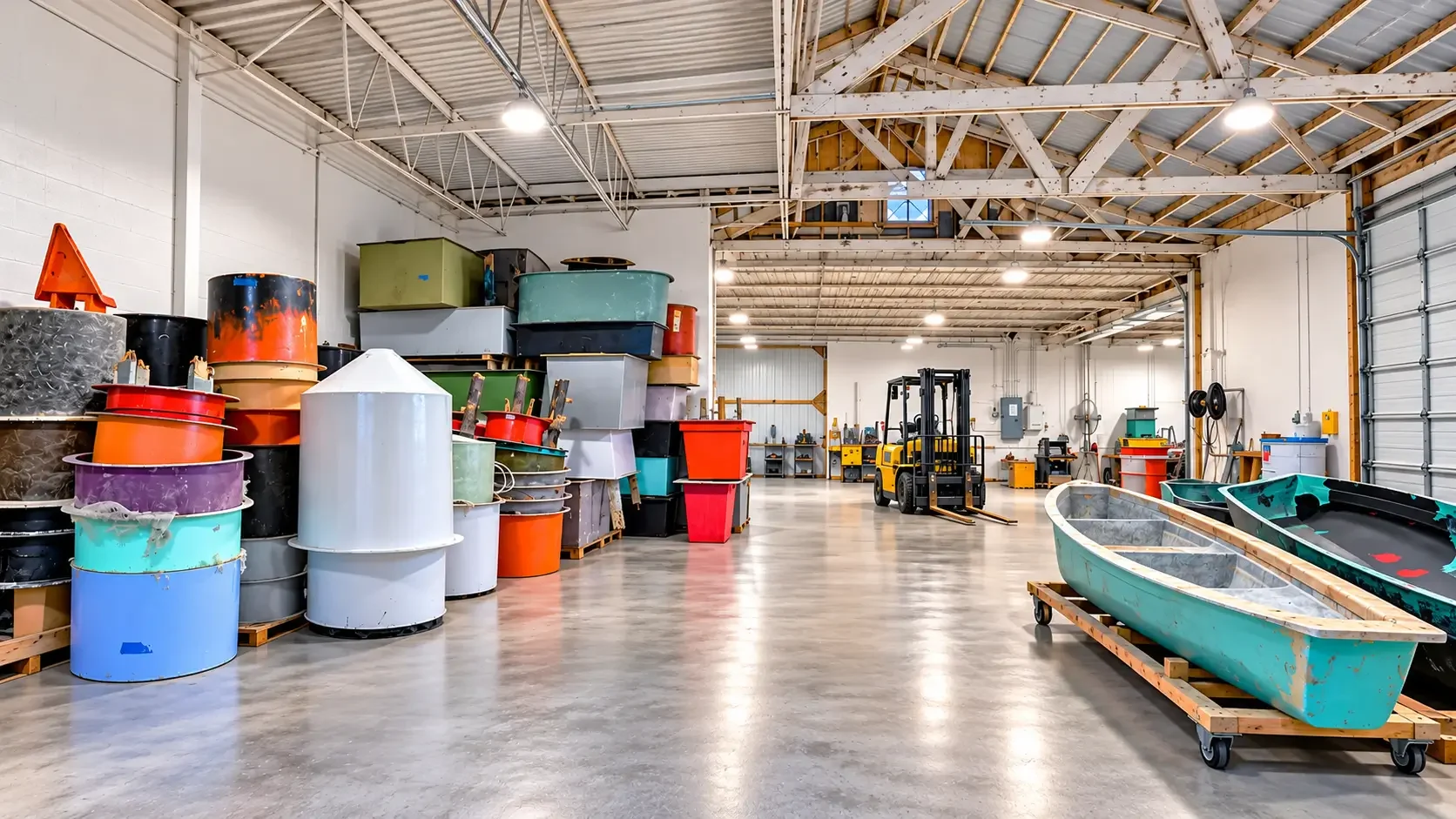
Water and wastewater: Storage tanks, filtration vessels and treatment systems. Our Fiberglass aquaculture tanks are built for hatcheries, nurseries and recirculating systems, where a smooth, non-porous interior makes cleaning and disinfection easier.
Industrial processing: Chemical tanks, scrubbers, ducting and containment. For systems that run under load, our Custom FRP pressure vessels resist the corrosion that shortens the life of many metal alternatives.
Marine and recreation: Boat hulls, canoes, kayaks and paddleboards.
Swimming pools: Factory-built pool shells that need no replastering or liner replacement.
Construction: Roofing panels, doors, window frames, grating and cladding.
Transportation and energy: Truck bodies, train interiors, wind turbine blades and body panels.
Molds and tooling: Composite molds used to form other fiberglass parts.
Insulation: Glass wool for buildings, appliances and sound control.
Is Fiberglass Safe? Handling and Environmental Notes
Finished, cured fiberglass is stable and safe to use. The risk is in the raw handling. Loose glass fibers and dust can irritate skin, eyes and lungs, so anyone cutting, sanding or laminating should wear gloves, eye protection, long sleeves and a respirator. The resins also release fumes during curing, so workshops need proper ventilation.
On sustainability, fiberglass has a mixed record. Its durability means fewer replacements and less waste over time. Recycling thermoset composites is still difficult, though, and the industry is working on better recovery methods such as reuse as filler and energy recovery.
Frequently Asked Questions
-
Not exactly. Glass fiber is the raw strand material. Fiberglass is the finished composite made when those fibers are bonded with resin.
-
It is a plastic-based composite. The resin is a polymer, and the glass fibers reinforce it, which is why it is often called fiberglass reinforced plastic.
-
By weight, yes, in many designs. Pound for pound, fiberglass composites can outperform steel. A thick steel section will still be stiffer, but fiberglass usually wins on corrosion resistance and ease of handling.
-
No. It contains no iron to rust and no organic fibers to decay. Its life depends mainly on the resin choice, the gel coat and how well the part was built.
-
With good design and the right resin, fiberglass products commonly serve for decades. Tanks, pools and boats regularly reach 20 to 30 years or more with routine care.
-
Yes. Damaged areas can be ground back, re-laminated with new fiber and resin, and refinished. This is one of its practical advantages.
-
Yes. Size, shape, wall thickness, fittings, flanges and colors can all be tailored, which is why it suits one-off industrial equipment.
Talk to a Fiberglass Manufacturer You Can Actually Reach
Understanding the material is the first step. Choosing the right resin, fiber schedule and build method for your project is where experience pays off. Level 08 Composite Structures has built tanks, pressure vessels, pool shells, molds and canoes in Cocoa, Florida, since 1991, and we ship across the United States.
Have a project in mind? Request a quote or call +1 (315) 262 6612, and our team will help you work out the best fit.