
An in-depth guide to tank durability, cost, sanitation, customization, and long-term performance in commercial fish farming and recirculating aquaculture systems.
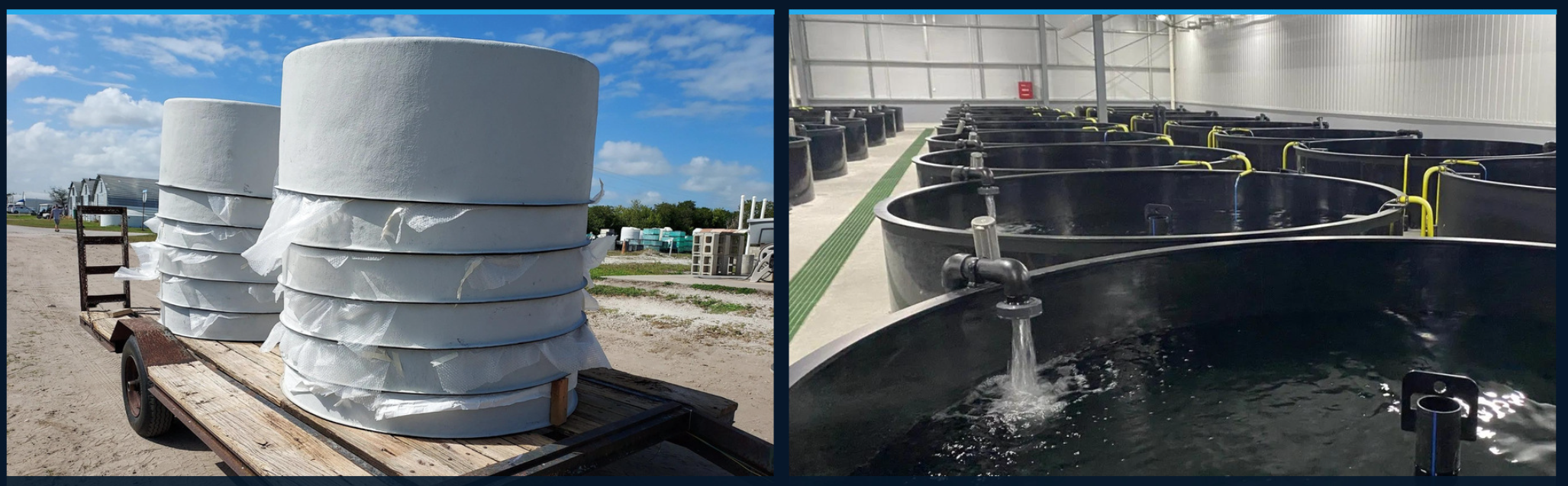
Choosing the right tank for a commercial aquaculture facility isn't simply about finding something that holds water.
If it were, a large plastic container and a garden hose would solve half the industry's problems.
In reality, your tanks influence water circulation, waste removal, cleaning procedures, equipment integration, and daily operating costs. Whether you're expanding a commercial fish farm, designing a recirculating aquaculture system (RAS), or upgrading a research hatchery, the materials you select can affect your operation for years.
Two of the most common choices are fiberglass-reinforced plastic (FRP) and high-density polyethylene (HDPE).
Both materials have proven applications in aquaculture. Both resist corrosion, and both can be manufactured into practical fish-rearing tanks. However, their structural characteristics, fabrication methods, customization options, and upfront costs differ.
At LEVEL 08, we manufacture custom fiberglass aquaculture tanks in Cocoa, Florida. Our work includes round tanks, rectangular tanks, raceways, cone-bottom tanks, and specialized FRP components for commercial aquaculture operations.
We've put together this guide to help you understand where each material performs best and how to make a purchasing decision based on actual operating requirements—not just a manufacturer's sales pitch.
Fiberglass vs. Polyethylene Tanks: The Quick Answer
Polyethylene tanks are often the more economical choice for standard sizes and straightforward applications. Fiberglass tanks become particularly attractive when structural rigidity, custom dimensions, specialized fittings, or integration into a commercial RAS are important.
Neither material is automatically better in every situation.
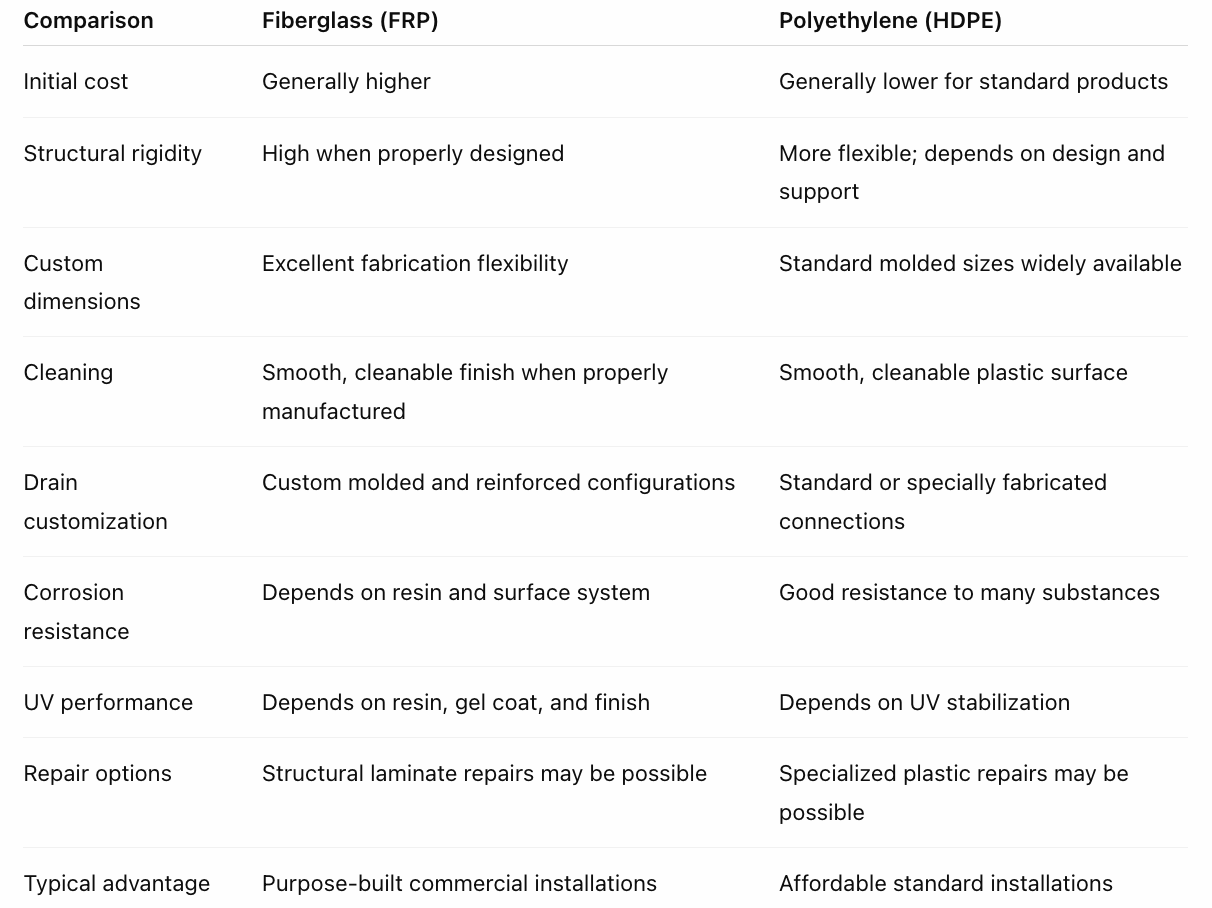
The important distinction is that fiberglass tanks are reinforced composites, while polyethylene tanks are thermoplastic structures. Their different mechanical properties influence how they are designed, supported, and manufactured.
Let's explore what those differences mean in a working aquaculture facility.
1. Understanding Fiberglass Aquaculture Tanks
Fiberglass tanks are manufactured using glass-fiber reinforcement combined with a resin system.
Instead of relying on a single homogeneous plastic wall, fiberglass-reinforced plastic uses fibers and resin together to provide structural performance.
Depending on the design, manufacturers may use chopped fiberglass, woven roving, biaxial reinforcement, and localized structural reinforcements.
A properly specified fiberglass aquaculture tank can also incorporate a smooth interior gel-coat system, customized plumbing connections, structural flanges, and specialized bottom geometries.
This construction makes fiberglass particularly useful when an aquaculture facility needs something beyond a standard molded tank.
Why fiberglass is commonly used in aquaculture
Researchers and extension specialists have recognized the advantages of fiberglass in fish-rearing systems for decades.
Oklahoma State University's aquaponics guidance identifies fiberglass as an especially suitable material for rearing tanks, sumps, and filter tanks because of its durability, practical handling, and plumbing compatibility.
Fiberglass is also attractive because a manufacturer can select the reinforcement schedule, wall construction, and surface system around the intended application.
For example, a shallow hatchery nursery tank and a large grow-out tank may require different structural designs, even if both are made using fiberglass.
At LEVEL 08, we fabricate custom fiberglass aquaculture tanks around the customer's required dimensions, operating conditions, and equipment layout.
The objective is not simply to manufacture a stronger tank. It is to manufacture a tank appropriate for the intended service.
2. Understanding Polyethylene Aquaculture Tanks
Polyethylene tanks are commonly manufactured through rotational molding or other thermoplastic fabrication processes.
High-density polyethylene is popular because it is lightweight, resistant to many chemicals, and relatively economical for standardized products.
You can find polyethylene tanks throughout agriculture, aquaculture, water storage, and industrial applications.
For smaller operations, their affordability and availability are significant advantages.
Why polyethylene remains popular
Polyethylene tanks make sense when an operator needs:
A readily available standard tank
A relatively low initial investment
Lightweight equipment
Straightforward plumbing arrangements
A simple holding or production configuration
A properly manufactured HDPE tank can perform reliably in commercial settings when used within its design limitations.
Polyethylene is not inherently unsuitable for serious aquaculture. In fact, many commercial systems use HDPE successfully.
Its limitations become more noticeable when a facility requires unusual dimensions, extensive custom fabrication, or structural configurations that are difficult to produce economically using available molds and fabrication techniques.
That brings us to the first major comparison.
3. Durability and Structural Strength: Does Fiberglass Last Longer?
Durability is one of the most important considerations when selecting commercial aquaculture equipment.
A tank may be exposed to constant hydrostatic loading, routine cleaning, vibration from connected equipment, chemical disinfectants, sunlight, and repeated production cycles.
Over time, those conditions can influence structural performance.
Fiberglass structural advantages
Fiberglass reinforcement allows manufacturers to develop relatively rigid tank walls and incorporate additional material where structural demands are higher.
For example, a rectangular tank with long, flat walls may require stiffeners or localized reinforcement to limit wall deflection.
A tank with multiple bulkhead penetrations may need additional laminate around its openings.
A large tank supported above the floor may require a different reinforcement schedule than a tank resting on a continuous foundation.
Proper fiberglass fabrication makes it possible to address these requirements during manufacturing.
Polyethylene structural considerations
HDPE is generally more flexible than a comparable rigid fiberglass laminate.
That flexibility is not inherently a weakness. However, it must be considered when designing supports, fittings, and structural connections.
Some large polyethylene tanks require external support or additional wall design considerations to prevent excessive deformation.
The appropriate solution depends on the tank's dimensions, wall construction, material grade, temperature, and operating loads.
What does independent research suggest?
Purdue University Extension identifies durability, longevity, customization, and repairability among the important advantages of fiberglass tanks.
However, those characteristics do not guarantee a particular service life.
A poorly manufactured fiberglass tank can fail prematurely, just as an inadequately supported polyethylene tank can develop problems.
The bottom line: Fiberglass offers valuable structural design flexibility, particularly for larger or customized installations. Actual durability depends on engineering, material quality, installation, and maintenance.
4. Cleaning, Sanitation, and Biosecurity
In commercial aquaculture, cleaning is more than a maintenance task. It is part of production management.
Hatcheries, nurseries, and research facilities may need to clean and disinfect tanks between batches to manage contamination risks and prepare equipment for the next production cycle.
The material and surface condition of a tank can influence how effectively that work is performed.
Cleaning fiberglass tanks
Fiberglass aquaculture tanks can be manufactured with smooth gel-coated interiors.
A properly finished surface eliminates many of the rough areas that can make cleaning more difficult.
Smooth walls, carefully detailed corners, and practical drainage configurations can improve access during washdown.
However, fiberglass surfaces require appropriate maintenance. Scratched, damaged, or deteriorated gel coat can become more difficult to clean and may need restoration.
Cleaning chemicals must also be compatible with the resin and coating system.
Cleaning polyethylene tanks
HDPE is also nonporous and can provide an easy-to-clean surface.
A well-maintained polyethylene tank is not inherently less sanitary than a fiberglass tank.
Both materials can support effective cleaning and disinfection when the surfaces are maintained and appropriate procedures are followed.
The differences often emerge from tank design, surface condition, seams, plumbing details, and the cleaning methods used.
Why tank geometry matters
Imagine two tanks with identical capacities.
One has a smooth interior, accessible corners, and drainage designed to remove accumulated solids.
The other has difficult-to-reach areas and a drain configuration that leaves residue behind.
Even if both tanks use excellent materials, the first may be easier to maintain.
For commercial aquaculture, good sanitation depends on the complete tank design—not simply whether the wall is fiberglass or polyethylene.
At LEVEL 08, we consider interior finishes, tank geometry, and drainage arrangements as part of custom fabrication planning.
5. Tank Geometry and Water Circulation: A Critical Design Factor
One of the biggest mistakes in aquaculture tank selection is concentrating on construction material while overlooking hydraulic performance.
Tank geometry can affect:
Water circulation patterns
Solids movement
Dead-zone formation
Oxygen distribution
Cleaning requirements
Fish handling and harvesting
Research published through the Southern Regional Aquaculture Center explains why circular tanks are widely used in recirculating aquaculture systems.
Their geometry offers structural and hydrodynamic advantages, including the potential for effective solids transport toward central drains.
However, this performance depends on properly designed water inlets, flow rates, drainage, and tank proportions.
Round fiberglass tanks
Round tanks are useful for many hatchery, nursery, and grow-out applications.
They can be configured with central drains, appropriate inlets, and specialized bottom profiles.
Rectangular fiberglass tanks
Rectangular tanks are useful when floor-space efficiency, equipment positioning, or specific production workflows are priorities.
They are commonly considered for research facilities, raceways, and specialized hatchery operations.
Because their flat walls carry water loads differently from circular walls, their structural design requires particular attention.
Cone-bottom fiberglass tanks
Cone-bottom tanks can support gravity-assisted drainage and solids collection when appropriately integrated with the system's hydraulic design.
These configurations may be attractive for specialty filtration, settling, and aquaculture equipment.
Which geometry is best?
There is no universal winner.
A circular tank may be ideal for one RAS installation, while a rectangular raceway may be better for another.
That is why LEVEL 08 provides Custom FRP Fabrication for facilities whose requirements cannot be satisfied by standard equipment alone.
6. Customization: Where Fiberglass Has a Major Advantage
Every commercial aquaculture facility has physical constraints.
You might be working inside an existing building, expanding around installed plumbing, or developing a new RAS with a tightly planned equipment layout.
Standard tank dimensions do not always cooperate.
Fiberglass fabrication offers flexibility in designing tanks around specific requirements.
Depending on the project, custom features may include:
Specific diameters, lengths, widths, and depths
Reinforced top flanges
Bottom drains and side outlets
Custom bulkhead locations
Cone-bottom configurations
Internal partitions
Removable lids
Equipment mounting provisions
Specialized interior finishes
Polyethylene can also be customized through suitable fabrication methods, but one-off geometries may be less economical or have different structural limitations.
A practical example
Suppose a hatchery requires a rectangular tank measuring 14 feet long, 4 feet wide, and 4 feet high.
The facility has a narrow installation footprint, specific plumbing locations, and a need for removable internal partitions.
A standard molded tank might not match those requirements.
Custom fiberglass fabrication allows the manufacturer to evaluate the geometry, wall reinforcement, flange construction, and connection details together.
That can reduce the need for awkward modifications during installation.
Sometimes the most valuable feature of a custom tank is simply that it fits where it is supposed to.
7. Fiberglass vs. Polyethylene Tank Costs
Let's address one of the biggest purchasing considerations: price.
For standardized smaller tanks, polyethylene will often cost less than custom fiberglass.
A rotationally molded polyethylene tank can benefit from repeat manufacturing using established tooling.
Custom fiberglass fabrication may require more labor-intensive reinforcement, finishing, and quality-control work.
If a new mold is necessary, tooling costs can also influence the quotation.
Why fiberglass tanks may cost more
Fiberglass pricing can be affected by:
Tank dimensions and surface area
Laminate thickness and reinforcement schedule
Resin and gel-coat requirements
Tooling availability
Complexity of the tank geometry
Drains, fittings, and structural details
Manufacturing quantity
Freight and handling
However, purchase price alone does not establish long-term value.
A more useful comparison includes the total cost of ownership.
Total cost of ownership
When comparing tanks, consider:
Total ownership cost = Purchase price + Installation + Maintenance + Cleaning labor + Downtime + Repairs + Replacement costs
For example, a tank that costs less initially may require additional fabrication or installation work to fit an existing system.
A custom tank may cost more at the outset but eliminate certain installation compromises.
Neither outcome is guaranteed.
The correct approach is to evaluate the complete project rather than comparing prices per gallon alone.
For additional budgeting guidance, read our custom fiberglass tank pricing guide.
8. UV Resistance and Outdoor Installation
Outdoor aquaculture tanks must contend with sunlight, rain, temperature changes, and environmental exposure.
Both fiberglass and polyethylene can be formulated for outdoor applications.
Fiberglass UV resistance
Suitable gel coats and protective surface systems can help shield fiberglass laminates from ultraviolet exposure.
Over time, however, an exposed fiberglass finish may fade, chalk, or require maintenance.
The type of resin, gel coat, and application quality all influence performance.
Polyethylene UV resistance
Polyethylene tanks intended for outdoor use are often manufactured with UV stabilizers.
UV-stabilized HDPE can perform well outdoors, but its longevity depends on formulation, exposure conditions, and product design.
Unstabilized polyethylene may deteriorate under prolonged UV exposure.
The practical lesson: Ask your supplier about the specific material and outdoor service requirements. Neither fiberglass nor polyethylene should be assumed to have unlimited UV resistance.
9. Repairs, Maintenance, and Replacement
Commercial aquaculture equipment is an investment, and repairs can become an important part of its service life.
One advantage of fiberglass construction is that certain damaged laminate areas can be repaired through established composite repair techniques.
Depending on the damage, a repair may involve removing compromised material, restoring reinforcement, and applying an appropriate surface finish.
However, not every damaged tank is suitable for repair. Structural damage requires proper assessment.
Polyethylene tanks may also be repairable using compatible plastic welding methods, although repair feasibility depends on the specific material, damage location, and operating conditions.
For either material, repairs must be evaluated for structural integrity, watertightness, and suitability for continued aquaculture use.
The goal should always be reliable service—not simply getting the tank to hold water until Friday.
10. Fish Safety: What Buyers Should Know
Regardless of material, aquaculture tanks must be suitable for contact with the intended culture water and aquatic organisms.
For fiberglass tanks, resin chemistry, surface coatings, curing, and manufacturing residues should be considered.
An incompletely cured or incompatible resin system can create problems for sensitive aquatic applications.
Likewise, polyethylene tanks should be manufactured using appropriate materials for the intended aquatic environment.
A tank labeled simply as "plastic" or "fiberglass" is not enough information to confirm suitability.
Before placing a new tank into service, follow the manufacturer's conditioning, cleaning, inspection, and commissioning recommendations.
For sensitive hatcheries or research applications, additional water-quality verification may be appropriate.
Material selection, proper curing, cleaning, and commissioning all matter.
11. Which Tank Should You Choose for Your Aquaculture Facility?
Here is a practical way to approach the decision.
Choose polyethylene when:
Your budget is limited.
Standard dimensions meet your requirements.
You need a simple holding tank.
Custom fittings are minimal.
A suitable tank is readily available.
The design and support requirements can be met economically.
Consider fiberglass when:
You're developing a commercial RAS or hatchery.
You need custom sizes or unusual geometries.
Multiple drains or fittings must be precisely located.
Structural rigidity is important.
You want purpose-built raceways or cone-bottom tanks.
You need a smooth, specified interior finish.
You anticipate repeated production cycles and long-term facility operation.
There is another important possibility: using both materials in the same facility.
A commercial aquaculture system may use polyethylene for certain simple holding or support applications while relying on custom fiberglass tanks for more specialized production stages.
The objective is not to make every component out of the same material.
It is to select the right material for each job.
12. What to Ask Before Ordering a Commercial Aquaculture Tank
Before requesting a quote, gather the following information:
Application: Will the tank be used for broodstock, hatchery, nursery, grow-out, quarantine, filtration, or temporary holding?
Dimensions: What capacity and physical footprint are required?
Water conditions: Freshwater, saltwater, or another operating environment? What are the anticipated temperatures and cleaning chemicals?
Drainage: What types of bottom drains, overflows, and outlets are necessary?
Support: Will the tank rest on a continuous foundation, an elevated platform, or a structural frame?
Quantity: Are you purchasing one tank or planning repeat production?
Delivery: Where will the tank be shipped, and are there unloading or access limitations?
If you already have engineering drawings, CAD models, or a rough sketch, those are valuable starting points.
The more clearly you define the application, the easier it becomes for a manufacturer to provide a meaningful quotation.
Why Choose LEVEL 08 for Custom Fiberglass Aquaculture Tanks?
LEVEL 08 is a Florida-based manufacturer specializing in custom fiberglass-reinforced plastic products.
Our composite manufacturing heritage traces back to 1991 through American Eagle's fiberglass craftsmanship.
Today, our capabilities include custom aquaculture tanks, industrial FRP components, composite molds, and specialized fabrication.
We work with customers who need equipment manufactured around real operational requirements.
Custom fabrication
We manufacture round, rectangular, oval, and cone-bottom tank configurations, as well as raceways and specialty fiberglass components.
Manufacturing flexibility
Our capabilities include mold fabrication, laminate construction, gel-coat finishing, and project-specific composite manufacturing.
Design and production input
We review project requirements, dimensions, materials, and fabrication considerations to help translate a customer's concept into a manufacturable product.
American-made manufacturing
Our products are fabricated in Cocoa, Florida, with projects serving customers beyond the state.
We understand that purchasing a commercial aquaculture tank is not simply ordering another piece of equipment.
You're making a decision that affects your facility's workflow, production efficiency, and long-term operating costs.
Our objective is to manufacture a product that meets those requirements rather than forcing your operation to work around an unsuitable standard design.
Frequently Asked Questions
Are fiberglass tanks better than polyethylene tanks for fish farming?
Fiberglass tanks can offer advantages in structural rigidity, customization, and specialized configurations. Polyethylene tanks can offer lower initial costs and convenient standard sizes. The better material depends on the facility's operating requirements.
Are fiberglass tanks safe for fish?
Fiberglass tanks manufactured with suitable materials, adequately cured resin systems, and appropriate interior finishes can be used for aquatic applications. Material compatibility and commissioning are essential.
Are polyethylene tanks suitable for commercial RAS systems?
Yes. Properly designed polyethylene tanks are used successfully in aquaculture. Their suitability depends on dimensions, structural support, hydraulic requirements, fittings, and operating conditions.
Are fiberglass fish tanks easier to clean?
Smooth, properly maintained fiberglass interiors can be easy to clean. However, polyethylene can also provide a smooth, cleanable surface. Tank geometry, finish condition, drainage, and cleaning procedures are important factors.
Which tank material lasts longer?
Fiberglass may offer service-life advantages in certain demanding applications, but neither material has a guaranteed lifespan. Manufacturing quality, UV exposure, structural loading, maintenance, and operating conditions all matter.
Why are custom fiberglass aquaculture tanks more expensive?
Custom fiberglass tanks may require specialized molds, additional reinforcement, specific resin systems, custom fittings, and more fabrication labor. Those costs can be justified when the installation requires capabilities unavailable in a standard product.
Can LEVEL 08 manufacture tanks to specific dimensions?
Yes. LEVEL 08 offers custom fiberglass fabrication for aquaculture tanks and related components, subject to design requirements and manufacturing feasibility.
Final Verdict: Fiberglass or Polyethylene?
Both fiberglass and polyethylene have legitimate roles in commercial aquaculture.
For smaller, standardized, budget-sensitive applications, polyethylene may be the most practical choice.
For facilities requiring custom configurations, structural rigidity, specialized drainage, and carefully planned integration into commercial production systems, fiberglass often deserves serious consideration.
But the most important question is not simply which material is stronger or which tank costs less.
It's which tank will perform reliably in your facility, support your operating requirements, and deliver the best value over its working life.
A good tank should do more than hold water.
It should make the operation around it work better.
Planning a Commercial Aquaculture Tank Project?
Whether you're designing a new recirculating aquaculture system, expanding a hatchery, replacing aging tanks, or developing specialized research equipment, LEVEL 08 can help evaluate your fiberglass fabrication requirements.
We manufacture custom tanks and FRP components in Cocoa, Florida, with configurations tailored to the customer's specifications.
Have dimensions, a drawing, or an idea?
Tell us what you're building, how the system operates, and what you need the tank to accomplish.
Request a Custom Fiberglass Tank Quote
Explore Our Aquaculture Tank Capabilities
LEVEL 08 Composite Structures & Fabrication
798 Clearlake Road, Unit #106
Cocoa, FL 32922
Phone: (315) 262-6612
Email: sagar@level08compositestructures.com
American-made composite manufacturing. Built around your application.
Research and Technical References
Oklahoma State University Extension — Recirculating Aquaculture Tank Production Systems — Discussion of fiberglass and polyethylene materials used in aquatic systems.
Purdue University Extension — Fiberglass Tanks for Storage, Transport, and Application — Material construction, customization, durability, inspection, and repair considerations.
Southern Regional Aquaculture Center — Recirculating Aquaculture Tank Production Systems: A Review of Current Design Practice — Circular tank design, hydrodynamics, and RAS operating considerations.
Clemson University — Aquaponics: System Layout and Components — Aquatic system design, tank material selection, and tank geometry.
Technical note: General material properties do not establish an individual tank's engineering approval or fitness for a specific application. Final specifications should be reviewed against actual service conditions.